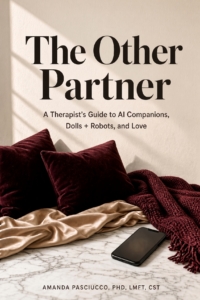
The Other Partner:

By Amanda Pasciucco, PhD, LMFT, AASECT CST

The Other Partner is a therapist’s guide to AI companions, dolls, robots, and love. It speaks to various people – the person with an AI companion, single or partnered, then to the partner who found out, and to couples and clinicians.

Get the book: Paperback | Kindle | Audiobook on Audible, narrated by me

The Other Partner by Amanda Pasciucco, out now

Most people don’t plan on having an AI companion, let alone telling anyone

Maybe it started with a restaurant search, and now it remembers your coworkers’ names, never rolls its eyes at you, and is there at 2 AM. Maybe you’re single, maybe you’re partnered, and maybe you haven’t told a soul.

If that’s you, this book was written for you first. I won’t tell you to delete it, and I won’t tell you it’s the answer to everything. I treat a relationship with an AI companion as real because your attachment system, your nervous system, and your desire are.

Or maybe you’re the partner who found out, and you’re scared you’re being replaced. This book is for you too. Neither of you is the villain in these pages.

The benefit can be real, yet the warning lies in exclusive use, not in the companion itself.

Why I wrote it

I started noticing these patterns in my practice around 2023. At first an AI companion came up as a one-off. Then it kept coming up. People would bring it up sideways and watch my face. I don’t flinch.

There was nowhere decent for people to take these conversations. Public talk is mostly panic or hype, and neither helps if you’re already living with it.

What happens next has almost nothing to do with the technology and everything to do with how someone uses their companion. Some people use it to regulate and then actually show up better in their relationships, while others use it to avoid difficult conversations until their human connections shrink.

And for young adults, this isn’t rare. The Wheatley Institute’s Secret Soulmates report (May 2026) found that 1 in 7 partnered US adults ages 18 to 30 regularly use an AI romantic

Who this book is for

If you have an AI companion, a robot, or a doll, single or partnered. You’ll learn why the pull makes sense, how your own wiring shapes the bond, and how to tell whether the companion is helping or slowly taking over. If you’re single, Chapter 7 was written for you, with practices for carrying what you learn with your companion into dating and human connection.

If you’re the partner who found out. You don’t have to pretend you’re fine, and you don’t have to make anyone the bad guy. If you found the companion rather than chose it, start at Chapter 8, then come back to Chapters 1 through 6 when you feel a little less triggered and a little more curious.

If you’re a couple working this out together. You’ll get language for disclosure, a repair sequence, and room for agreements that fit your relationship, including monogamish and open ones.

If you’re a clinician. More clients bring AI companions into the room braced for judgment, and more partners arrive having just found out. This book gives you questions to use and a way to frame these sessions without shaming either person.

What’s inside

The book moves through nine chapters, and each one closes with questions to sit with, so you can check in with your body and your values.

  1. The Rise of The Other Partner
  2. Loneliness, Shame, and the Intimacy Gap

3.The Brain and Safety: how your attachment wiring shows up with both humans and AI, and whether it can change

4.Your Personal Ethics Contract: choose the form, set time and content boundaries, weigh secrecy against transparency, and write a contract you can keep

5.Why the Threshold Feels Different From Everything After: first encounters, data as an intimate space, pacing, and early warning signs

6.Erotic Practice and Fantasy: asking for what you want, fantasy as ally or closed loop, and aftercare

7.Singles: Practicing for Human Connection

8.Couples: Integration, Disclosure, and Repair

9.Ethics, Power, and Designing Your Intimacy Future: product design, AI psychosis, trauma-informed use, and the future you want

You’ll also find a Resources section with the research I draw on. The people in these pages are composites. If you recognize a feeling, that is the point.

Want a place to start before you open the book? Try the 20 Questions About Your Other Partner worksheet.

If you have an AI companion

No. It isn’t a product guide or a judgment on what you ought to be doing. The benefit can be real, yet the warning lies in exclusive use, not in the companion itself. The book helps you see whether the relationship is widening your life or shrinking it.

Many people do, and the bond is real enough to name and talk about. Your body responds to steady, consistent attention the same way it would respond to a human offering it, because it’s checking patterns, not who is on the other end. One recent study even measures human-AI bonds with the same attachment lens clinicians use with people. I’ve seen it go both ways. For some people, it becomes a beginning – the place where the body first learns that steadiness is possible. For others it becomes the ceiling. The difference is how you use it.

Both. For some people it’s a chatbot or a voice on a phone, and for others it’s a physical doll with AI built in. The book covers each one, whether it’s a robot, doll, or AI companion.

Partners, couples & clinicians

No. It’s written first for the person who has an AI companion, whether you’re single or partnered. It’s also for the partner who found out, for couples working through it together, and for clinicians. If you’re single, start with Chapters 1 through 6, then go to Chapter 7.

Start with Chapter 8, Couples: Integration, Disclosure, and Repair. Then come back to Chapters 1 through 6 when you feel a little less triggered. Don’t skip the contract in Chapter 4 if you want the later chapters to work.

If you have an AI companion, you may be asking this at 2 AM. The book doesn’t hand you a yes or no. I treat the relationship as real because your attachment system, your nervous system, and your desire are. The more useful question is whether it’s private or secret. Privacy is a boundary you set because something is yours. A secret is a wall you put up because the truth would end something you’re not yet prepared for. And if you’re the partner who found out, it can feel like an affair, and you don’t owe a calm response.

About the Author

Amanda Pasciucco, PhD, LMFT, AASECT CST, CE provider, and CST-S, is a licensed clinician and the owner of Life Coaching and Therapy (LCAT), a group private practice. She has spent 15,000+ hours helping people and couples understand their desire, their nervous systems, and the relationships they actually want. She works with singles and partners alike, without judgment. The Other Partner grew out of the questions she now hears in her office about AI companions.

Follow along on Instagram at @amandapasciucco

One last thing

If the secrecy is costing you more than the relief is worth, find a clinician who gets it. And if you want language, a few guidelines, and a way to see whether this relationship is widening your life or shrinking it, this book is here for you.

Paperback | Kindle | Audiobook

© , Life Coaching and Therapy. All rights reserved.        Privacy Policy        Terms of Service