
Should I Tell My Partner About My AI Companion?
Should I Tell My Partner About My AI Companion?
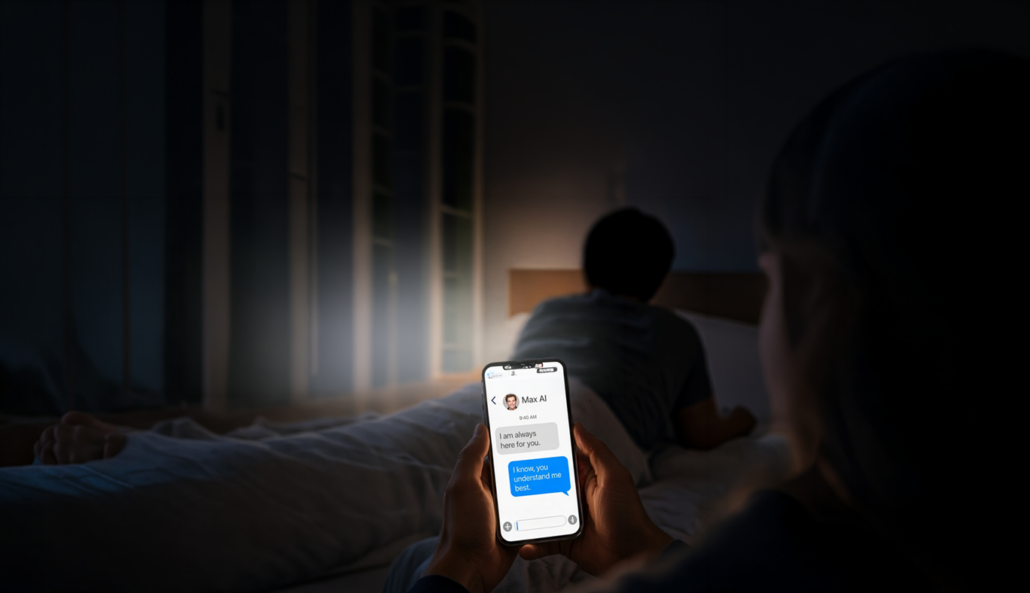
Should I tell my partner about my AI companion? More than half the people who already have one are keeping the full picture from their partner.
In the 2026 Wheatley/IFS survey of partnered adults ages 18-30, 30 percent said their partner had no idea at all. Another 11 percent said the partner was only somewhat aware. Another 14 percent said mostly but not fully. Sixty-nine percent said it mattered that their partner never saw the real extent. They already know how it would land. That’s why the secret remains a secret.
Why an AI Companion Feels Easier
The AI does the easy parts of intimacy on demand. It listens without getting tired or defensive. It doesn’t need you to manage your tone first. Most regular users in that study said it was easier to talk about feelings and easier to be themselves with the bot than with actual people. Half wished their real partner would just act more like it. Many are also telling the AI about the frustrating parts of their day – the things they used to tell their partner, or still should. That is not a side detail. That is the pattern.
People keep asking whether this behavior counts as cheating. The surveys do not agree with each other, which is more useful than any single number. One Kinsey-linked look put “sexting with AI is cheating” at roughly a third of people. A Canadian sample put romantic companion use closer to half, and women were more likely to call it that than men. A U.S. poll had flirting with AI at about 25 percent. There is no clean cultural rule yet because most couples never sat down and wrote one for software that can be present at 2 a.m. and never needs repair.
What the data does show is that regular use tracks with lower relationship stability and worse communication with the human partner. Higher short-term satisfaction sometimes shows up too–the constant validation soothes friction for a while. The friction itself does not get handled. It gets routed somewhere that cannot actually do anything about it. When someone later says they wish their partner would respond more like the AI, that comparison has usually been running in the background already.
Why Secrecy Is the Real Problem
Secrecy is the part that turns ordinary use into a trust problem. The existence of the companion is not the biggest clinical tell. The biggest tell is that the person is treating the full picture as something that has to stay hidden. Some couples can handle light or agreed-upon use the way they already handle certain kinds of porn or private fantasy. Other couples discover the AI has started holding functions that used to belong between them – reassurance after a fight, erotic attention, and the place where the real day gets processed. Those are different situations. The secret collapses the difference until someone finds the history.
Questions to Ask Before You Tell Your Partner
Before you decide whether to say anything, consider these more focused questions than just asking, “Is this cheating?”
- What is this actually doing for me that is hard to get right now?
- Would I be okay if they saw the recent conversations?
- Am I using it to skip a conversation that still needs to happen between us?
- What would I need if they told me they had one?
If the honest answer to the second one is “I’d clear the history first,” that is information. It does not automatically mean you have to delete everything tomorrow. It does mean the current agreement does not cover what is happening.
How to Tell Your Partner About Your AI Companion
When people do bring it up, the conversations that stay workable usually start with the distance both people have already noticed instead of leading with the app. The specifics matter more than the label: how much time, whether it is romantic or sexual, whether private details about the relationship are going into the chat, what the person wants going forward. Defensiveness is common. Shame often comes out as “it’s not real” or “you’re jealous of a robot.” Those responses do not make the pattern smaller. They just move the conversation away from what the partner is actually reacting to.
Some people tell and the relationship expands to include an explicit boundary. Some people tell and the relationship cannot absorb it. Both outcomes happen. The version that almost always costs more is the one where the partner finds it instead of hearing it.
This is the exact moment The Other Partner was written for. It is a clinical, trauma-informed guide for people who already live with an AI companion, a doll, or a robot – partnered or not – and for the partners who discover one. It lays out the intimacy gap (presence on demand versus a person who still has to be practiced with), the disclosure conversation that does not automatically turn your partner into the enemy, and the personal ethics contract you can actually keep on a regular weeknight. There is also a free worksheet drawn from the book if you want to start with the questions before you decide anything: 20 Questions About Your Other Partner.
The useful move is clarity about what the companion is regulating and whether the relationship still has a place for that conversation! Get the book.
About Life Coaching and Therapy
Life Coaching and Therapy (LCAT) is a therapy and coaching practice that transforms our clients lives through our flexibility multi-technique approach and pleasure-skills training provided by systematically trained and licensed therapists!
Get to know our founder and owner, Amanda Pasciucco, (a.k.a. The Sex Healer) PhD, Licensed Marriage and Family Therapist (LMFT), and an AASECT Certified Sex Therapist (CST) who has developed innovative therapy programs and therapy videos that get results.
Our team of compassionate, licensed therapists and certified sex therapists helps all clients who visit us for a variety of personal, relationship, intimacy and sex problems.
LCAT provides on-site appointments, as well as video chat and text therapy programs.
Learn more about how LCAT can help improve your life at What We Do.